I am the Nortel Networks Assistant Professor of Electrical & Computer Engineering with a secondary appointment in Computer Science at Duke University. I direct the FuNCtions Lab, working with a group of talented students on projects across the networking, communication, sensing, and energy-efficient computing aspects of wireless, mobile, optical, and quantum networked systems.
My research focuses on both theoretical and experimental aspects of massive antenna systems and millimeter-wave networks, optical and quantum networks, and spectrum sharing systems, and their convergence with edge cloud, energy-efficient computing, and AI/ML. I enjoy building efficient hardware–software systems and experimental testbeds at scale.
Before joining Duke in Fall 2021, I was a postdoc in Electrical Engineering at Yale University (2020–2021), working with Prof. Leandros Tassiulas and Prof. Lin Zhong. I received my Ph.D. in Electrical Engineering from Columbia University in 2020 (advisor: Prof. Gil Zussman) and my B.Eng. in Electronic Engineering from Tsinghua University in 2014.
I am always looking for motivated B.S., M.S., Ph.D. students and Postdocs to join my group at Duke ECE. If interested, email me your CV, transcript, and a brief note on your research interests.
Research areas
View all

Current projects
All projectsSelected publications
All publicationsRecent news
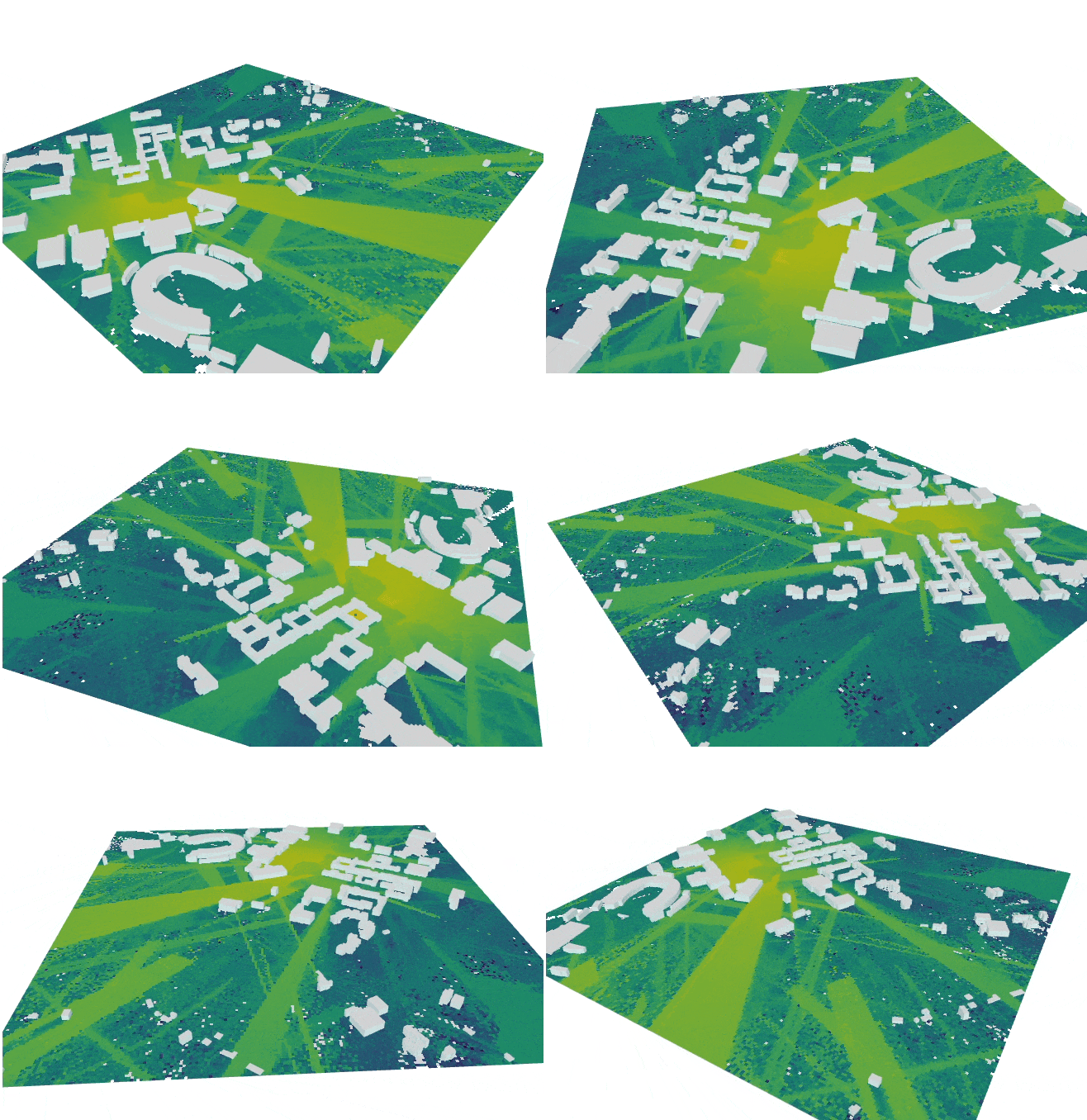
All newsProf. Chen gave a talk on “Scalable Wireless Digital Twins and ML Models for High-Fidelity RF Signal Mapping” at the OAI Foundation Hands-on Workshop at NC State.
Zhenzhou Qi successfully defended his Ph.D. dissertation and will join Samsung Research America as a Senior Researcher. Congratulations, Dr. Qi!
Prof. Chen served as a panelist on the “RF Data Solutions: Collecting, Storing, Publishing, Leveraging RF Data” panel at the NSF PAWR PI Meeting.
FuNCtions lab is part of the $15M renewal of the NSF AI Institute for Edge Computing and Systems (Athena), a 5-year award led by Duke to pursue the theme of “immersive AI in the physical world” across computing systems, foundational AI, physical AI, and applications. [Duke Pratt news]
FuNCtions lab is part of a $24M ARO ICE-CEM Center led by Duke focusing on inducing cyber and physical effects in unmanned aerial systems via cyber-EM convergence.
Prof. Chen is a co-PI of a 3-year, $4.1M NSF VINES Track 2 award on AReS, which aims to assess, restore, and support post-disaster connectivity and situational awareness through AI-enabled ISAC and ISAC-AR integration. This project is led by Princeton University, in collaboration with UC Santa Barbara, UW-Madison, and Ericsson.
A paper on in-situ radar sensing on 5G base stations with zero-shot template generation was accepted to ACM MobiHoc’26. [arXiv]
FuNCtions lab received a grant from ARO to work on real-time, scalable, and programmable radio architectures based on the RFSoC platforms leveraging AI and agentic workflows.
Prof. Chen is the PI of a $9M grant from ARO focused on RAPTORS–Rapid Analog Processing for Tactical Observation and Opportunistic Radio Spectrum Access. In collaboration with Professors Miroslav Pajic and David Smith (Duke), Arun Natarajan (Yale), Aravind Nagulu (Northeastern), and Raytheon BBN Technologies, this project aims to build intelligent sensing radios and networks with low SWaP-C.
A paper on optimizing arbitrary RF containment using tactical aerial networks and differentiable ray tracing was accepted to IEEE MILCOM’26.
Selected talks
Acknowledgments
Our research projects are supported in part by grants from NSF (VINES Track 1, VINES Track 2, CAREER, CIRC GRAND/ENS, CC* Integration-Large, NewSpectrum, EAGER, SII-NRDZ, CISE Core, SWIFT, and Athena AI Institute for Edge Computing), ARO (W911NF-26-2-A165, W911NF-26-2-A164, W911NF-26-2-A158, W911NF-25-1-0241), SRC/DARPA JUMP 2.0 Center for Ubiquitous Connectivity (CUbiC), Duke Science & Technology Initiative and Pratt School of Engineering, as well as grants and gifts from ACM SIGMOBILE, Enegis, Google, IBM, NEC Labs America, NTT, NVIDIA, and Supermicro. The findings, positions, or opinions of our research projects do not necessarily represent the official policy of any of these organizations.