Project Information
- Award Numbers: CNS-2128638, CNS-2128530, CNS-2128535
- Project Duration: 2021/10–2025/09
- Program: NSF Spectrum and Wireless Innovation enabled by Future Technologies (SWIFT)
- Principal Investigator: Prof. Tingjun Chen (Duke University)
- Co-Principal Investigators: Prof. Arun Natarajan (Oregon State University); Prof. Leandros Tassiulas (Yale University)
- Graduate Students: Wei Cheng, Zhihui Gao, Yiming Li, Zhenzhou Qi, Chung-Hsuan Tung, Zehao Wang (Duke)
- Undergraduate Students: Scarlett Francini, Zeyu Li, Yi-Chyun Wong, Yunjia Zhang, Junyao Zheng (Duke)
Project Overview
The last two decades have witnessed an enormous increase in wireless data transfer, impacting every aspect of our lives and our nation’s economy. This has led to a spectrum crunch in frequency bands below 6 GHz that are the most useful for intermediate and long-range wireless communications. Even as new spectrum is allocated for different wireless networks and systems, satisfying the increasing demand of high data rates will lead to coexistence of active users (that generate signals) and passive users (that sense signals for weather sensing, astronomy, and other applications). Inevitably, interference occurs when these users share the same frequency band or when active users operate in bands close to that used by passive users. Therefore, there is a critical need for an approach to efficiently manage and reduce such interference, which will allow for further improved spectrum usage. This project addresses this challenge and focuses on a cross-layer software-hardware approach for spectrum coexistence with rapid interferer learning, detection, and mitigation.
Specifically, this interdisciplinary project bridges the gap between the broad areas of integrated circuits, communications, networking, and machine learning, and focuses on enabling rapid interferer learning, detection, and mitigation for spectrum coexistence based on the co-design of novel RF hardware and network control architecture. The main activities include: (i) extensive spectrum measurements and data collection for characterizing the spectrum usage and properties of potential interferers, (ii) development of a novel reconfigurable 0.4–4.0 GHz MIMO receiver architecture leveraging a concurrent auxiliary receiver for rapid interference detection and N-path sequence-mixing for nulling specific interferers, and (iii) design of an intelligent control plane, which integrates software-defined networking and machine learning techniques, for efficient spectrum monitoring, management, and resource allocation across spatially distributed receivers. The developed hardware and software are evaluated in the lab setting and in real-world environments through their integration in a city-scale wireless testbed.
Key Results and Outcomes
- High-fidelity spectrum digital twins for signal strength mapping: We designed Geo2SigMap, a machine learning (ML)-based framework for efficient and high-fidelity RF signal mapping using geographic databases. Geo2SigMap features an automated framework that seamlessly integrates three open-source geospatial databases (e.g., OpenStreetMap, USGS lidar point cloud) and ray tracing (e.g., NVIDIA’s Sionna), enabling efficient generation of a massive number of large-scale 3D building maps and ray tracing models. At the core of Geo2SigMap is an ML model that can be pre-trained on purely synthetic ray tracing datasets and employed to generate detailed RF signal maps, leveraging environmental information and sparse measurement data. We evaluated Geo2SigMap via a real-world measurement campaign, where three types of user equipment (UE) collected over 45,000 data points from six LTE cells operating in the citizens broadband radio service (CBRS) band. Geo2SigMap achieves an average root-mean-square error (RMSE) of 6.0 dB for predicting the reference signal received power (RSRP) at the UE — an average RMSE improvement of 3.6 dB compared to existing methods.


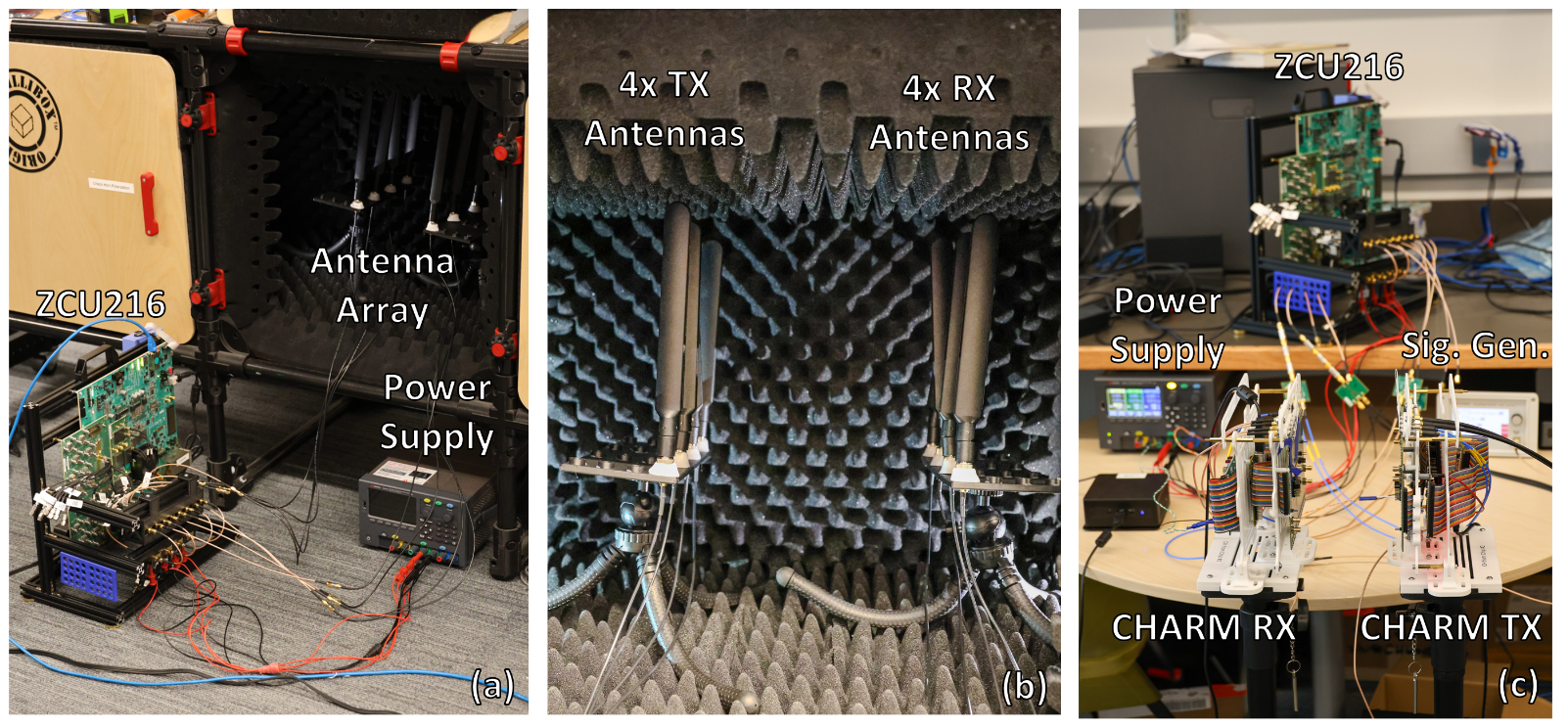
- Software-defined Python-enhanced RFSoC for wideband radio applications: We designed and implemented SPEAR, an SDR platform based on the Xilinx RFSoC ZCU216 evaluation board capable of supporting real-time, multi-channel (up to 16T16R), wideband (up to 1.25 GHz per channel) radio applications employing the direct RF radio architecture (MILCOM’25, WiNTECH’24).
Code and Dataset
- Geo2SigMap: github.com/functions-lab/geo2sigmap
- SPEAR / SPEAR+: github.com/functions-lab/SPEAR
Broader Impacts
This project focuses on a cross-layer software-hardware approach for spectrum coexistence with rapid interferer learning, detection, and mitigation. On a societal scale, the proposed research can improve spectrum utilization and increase access to in-demand wireless data without adversely impacting existing users, which will have direct economic impact. The broader impacts also include major outreach activities involving high-school students and aiming at broadening the participation of students in STEM fields, as well as incorporation of new hardware, software, and network architecture into undergraduate and graduate classes.