Project Information
- Award Numbers: CNS-2211944, CNS-2211945
- Project Duration: 2022/10–2026/09
- Program: NSF CISE, CNS Core
- Principal Investigator: Prof. Tingjun Chen (Duke University)
- Co-Principal Investigator: Prof. Lin Zhong (Yale University)
- Postdocs: Dr. Xiao Zhang (Duke); Dr. Parthiban Annamalai (Yale)
- Graduate Students: Wei Cheng, Zhihui Gao, Yiming Li, Zhenzhou Qi, Samuel Rivera, Chung-Hsuan Tung, Zehao Wang (Duke); Guojun Chen, In Gim, Ramla Ijaz, Zhiyao Ma, George Typaldos (Yale)
- Undergraduate Students: Scarlett Francini, Zeyu Li, Yi-Chyun Wong (Duke); Archit Kumar, Jordan Miller, Sebastian Orozco, Miranda Selin, Skylar Wang, Felix Zou (Yale)
Project Overview
Emerging applications in augmented reality, connected autonomous vehicles, and industrial IoT systems impose demanding requirements on next-generation mobile networks that can hardly be met alone with radio resources below 7 GHz. Therefore, 5G and beyond networks have embraced radios operating in millimeter-wave (mmWave) frequency bands, which offer 25 times or more bandwidth worldwide. On the other hand, mmWave radio networks require the dense deployment of infrastructure nodes to achieve desirable coverage, because mmWave radio signals suffer from high propagation loss and are vulnerable to blockage and mobility. Unfortunately, mmWave infrastructure nodes, e.g., gNodeB in 5G, are made of specialized, dedicated hardware and as a result, their dense deployment would incur formidable capital and operational cost.
The goal of the proposed project is to reduce the cost of mmWave radio infrastructure nodes by softwarizing their radio access network (RAN) functions and serving them from data centers close to end users, i.e., edge data centers, therefore facilitating network densification. More importantly, it will allow for previously impossible flexibility in network implementation and configuration as well as efficiency in resource allocation across the network and the edge data center. At the societal level, this project will fuel the ongoing revolution of mobile network virtualization and accelerate the development and deployment of next-generation network systems.
The key insight toward addressing the challenges associated with softwarizing mmWave RANs at the edge is to exploit the massive data parallelism inside the mmWave baseband and its inherent structures, with programmable hardware in all domains. The project targets the following scientific contributions in three interrelated research thrusts. (i) A low-latency software realization of the mmWave physical layer for commodity server clusters suitable for edge deployment. (ii) Adaptive RAN configuration and in-network compression schemes that cope with the limited fronthaul capacity in practice, without substantially increasing the cost of mmWave infrastructure nodes. (iii) Novel sensing and imaging schemes based on mmWave radio signals intended for communications. These include sensing with a single mmWave infrastructure node and sensing that leverages multiple coordinated mmWave nodes to achieve previously impossible coverage and resolution.
Key Results and Outcomes
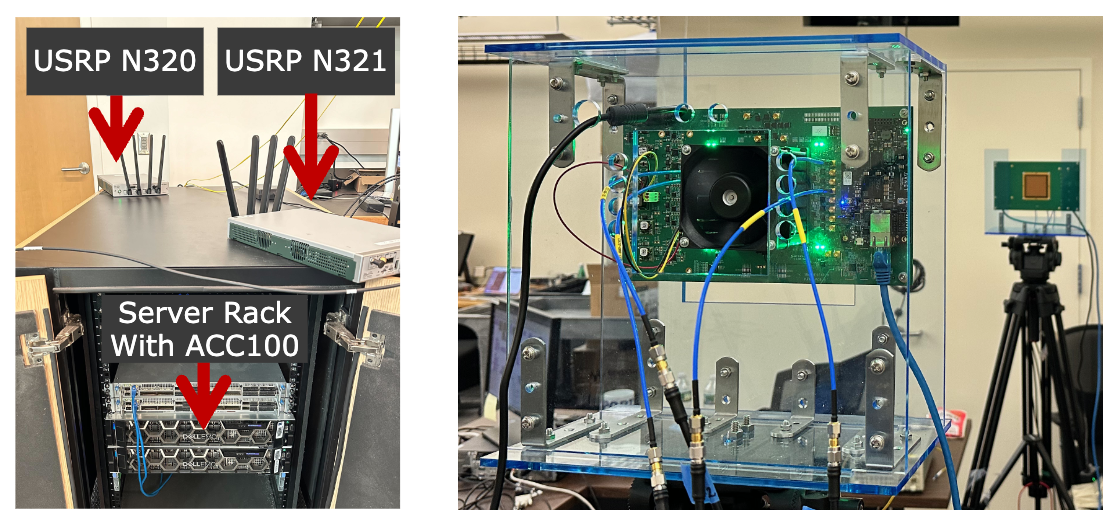
- Softwarization of baseband processing in mmWave vRANs: We designed real-time baseband processing frameworks for single-cell (Savannah) and multi-cell (Nexus) scenarios leveraging heterogeneous compute resources including CPUs (Intel’s Xeon processors) and ASICs (Intel’s ACC100 eASICs), with comprehensive power-latency profiling, modeling, and optimization (MobiCom’26, MobiCom’24, WiNTECH’23). We have also studied dynamic resource provisioning in elastic massive MIMO vRAN systems to dynamically allocate CPU cores for varying computational loads (HotMobile’25). We also developed DecodeX, a software suite for benchmarking LDPC decoding performance across CPU, GPU, and ASIC platforms (HotMobile’26).
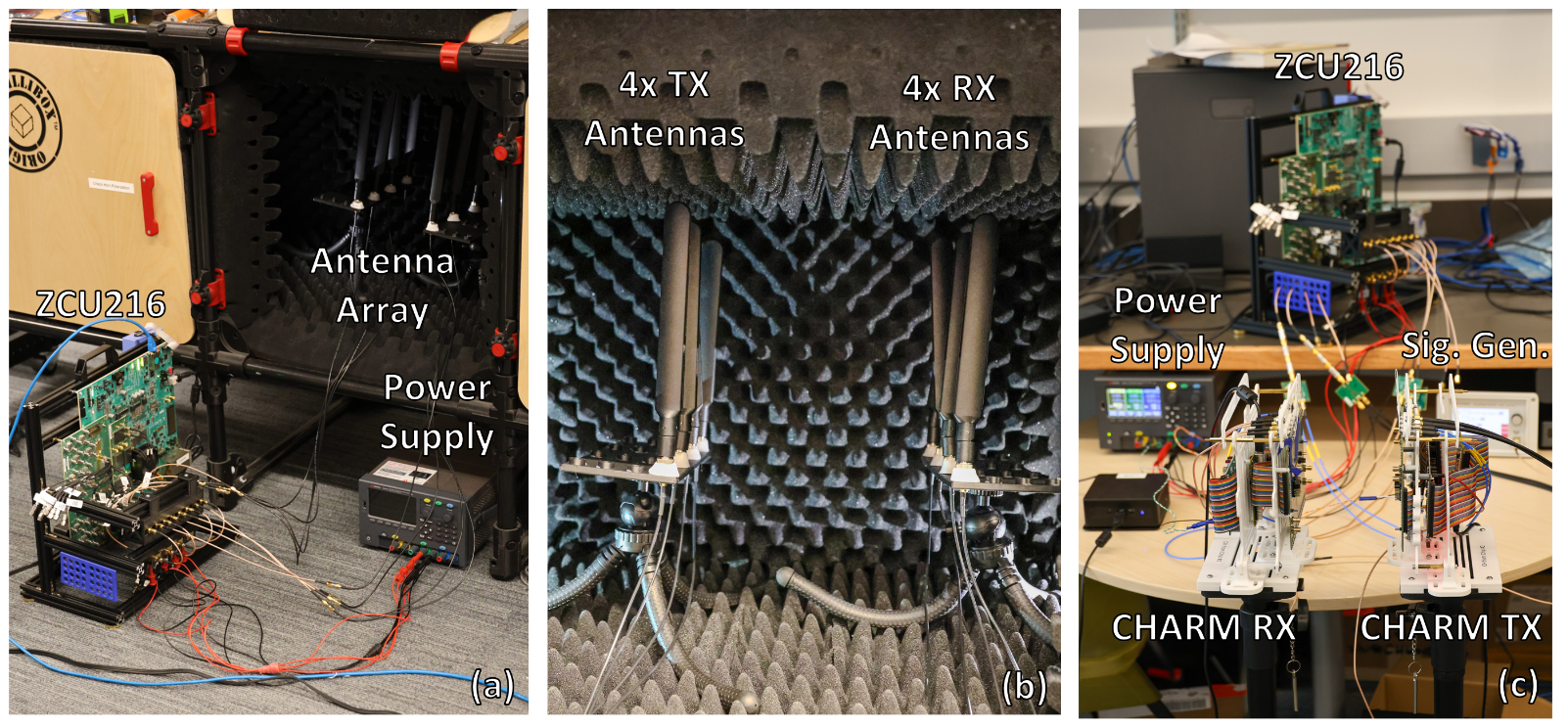
- Software-defined Python-enhanced RFSoC for wideband radio applications: We designed and implemented SPEAR, an SDR platform based on the Xilinx RFSoC ZCU216 evaluation board capable of supporting real-time, multi-channel (up to 16T16R), wideband (up to 1.25 GHz per channel) radio applications employing the direct RF radio architecture (MILCOM’25, WiNTECH’24).
-
Radio resource allocation and scheduling for communication and sensing: We developed Mambas, an analog multi-user beamforming tailored for mmWave networks employing the array of subarrays (ASA) architecture, supporting simultaneous communication with multiple users located in close proximity, even within the half-power beamwidth of the ASA (MobiCom’24). We developed Chameleon, a framework that augments and rapidly switches beamformers during each demodulation reference signal (DMRS) symbol to achieve integrated sensing and communication (ISAC) in 5G mmWave networks (RFSA’26). We also studied sectorized wireless mesh networks with beam-steering infrastructure nodes, characterized their capacity region and sectorization gain via a flow extension ratio, and developed a distributed optimization algorithm that computes near-optimal node sectorization with a 2/3 approximation guarantee to maximize network flow (TON’25, MobiHoc’23).
-
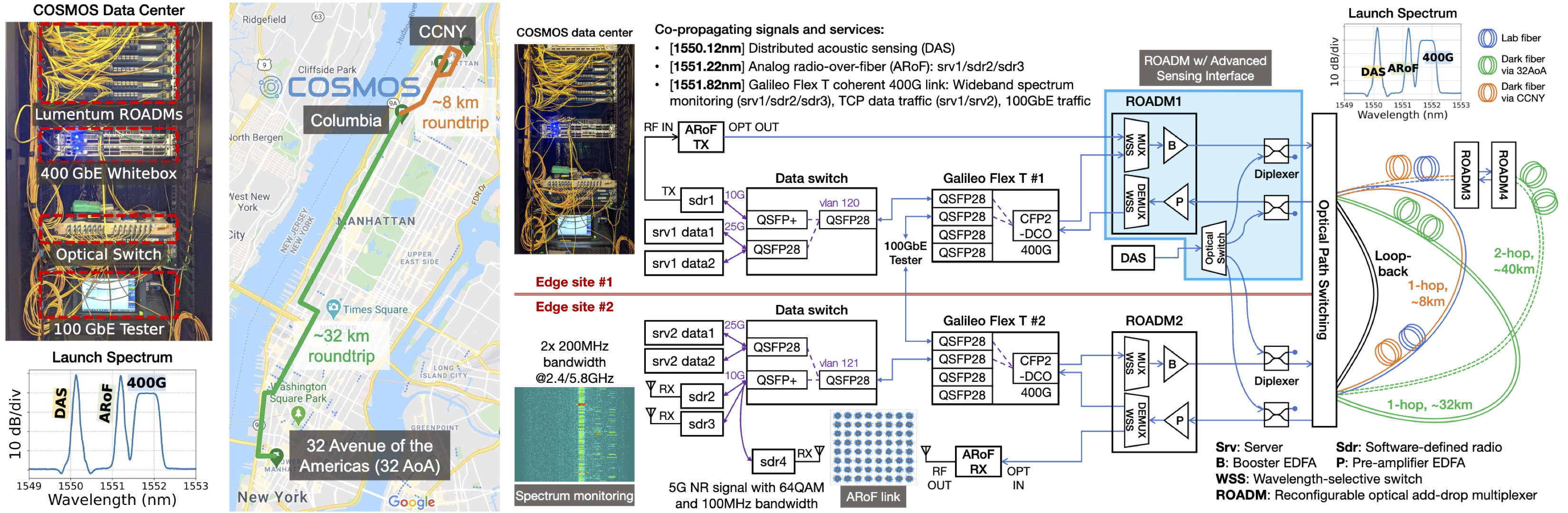
Modeling and optimization of optical fronthaul: We studied both component- and network-level modeling and optimization of reconfigurable optical fronthaul that serves as the underlying infrastructure connecting base stations with (edge) data centers. Through a series of lab experiments and field trials, we demonstrated reliable quality of transmission (QoT) estimation in the optical layer and co-existence of heterogeneous fronthaul traffics including 5G, wideband spectrum sensing based on analog radio-over-fiber (ARoF), and 400 GbE coherent optics (JOCN’26, JLT’25, JLT’24, OFC’25, OFC’24, OFC’23, ECOC’23).
Code and Dataset
- Savannah / Nexus: github.com/functions-lab/Savannah
- DecodeX: github.com/functions-lab/DecodeX
- SPEAR / SPEAR+: github.com/functions-lab/SPEAR
- Mambas: github.com/functions-lab/MAMBAS-MobiCom2024
- Agora: github.com/Agora-wireless/Agora
Broader Impacts
This project fuels the ongoing revolution of mobile network virtualization and accelerates the development and deployment of next-generation network systems. Specifically, it expedites the adoption of mmWave radios, resulting in more capable, more efficient, and more cost-effective mobile networks. We leverage our ongoing collaborations with industry leaders to ensure a timely transfer of technologies into industry and a broad impact on the commercial development of mobile networks, edge and cloud computing. By softwarizing wireless network functions at the lowest layer, this project provides a meeting ground for software systems and wireless communication research and creates timely content for teaching Computer Science majors about the wireless physical layer. The project also provides a platform to engage undergraduate and high-school students in wireless and computing research.